
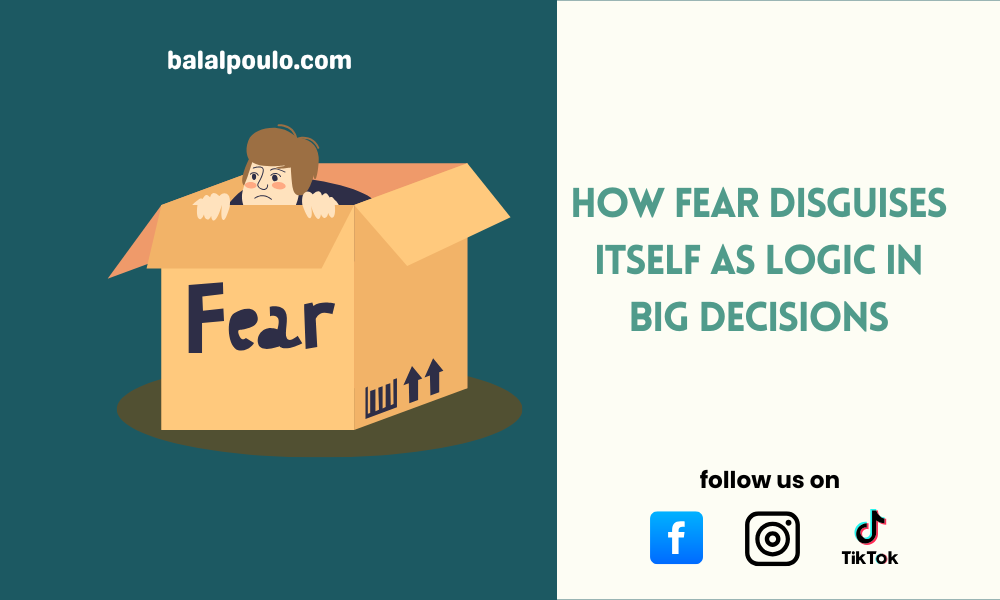
There is a reason your biggest regrets almost never came with a warning label. No alarm went off when you stayed in the job. No red flag appeared when you shelved the business idea. No voice said “this is fear talking” when you turned down the trip.
Instead, each time, you had a reason. A good one. The kind that held up when you said it out loud. That is exactly what should worry you.
You did not stay in the job you dislike because you were scared. You stayed because the timing was not right. You did not skip launching the business because you panicked. You skipped it because you wanted “a more solid plan” first.
You did not turn down the trip because you were afraid to go alone. You turned it down because it was not “the responsible use of the money.” That is the trick. Fear rarely shows up looking like fear.
This matters because most big decisions are not abandoned in a moment of obvious panic. They are abandoned calmly, over months, while you tell yourself a perfectly reasonable story.
Understanding how fear disguises itself as logic is the first step to noticing when your own reasoning, about money, about your career, about the life you actually want, has quietly become a cover story for avoidance.
5 Things You Should Know About How Fear Disguises Itself as Logic
1. Fear Borrows the Language of Caution
Fear almost never says “I am afraid.” It says “I am being careful.” It says “I am doing my research.” It says “I am waiting for the right moment.” A person turning down a promotion says they want to “make sure they are ready.”
A person who wants to quit a job they dislike says they are “being strategic” about timing. These phrases sound responsible, and sometimes they are.
But when the research never finishes and the right moment never arrives, the caution was never really about information. It was fear wearing a lab coat.
The way to catch this is to ask yourself a blunt question. If you removed the fear entirely, would you still need more research, or would you already know enough to act?
2. The Rationalization Compounds Over Time
Fear-based logic rarely appears all at once. It builds slowly, the way plaque builds in a pipe. One postponed decision needs a reason. That reason needs a follow-up reason six months later, because the first one has started to look thin.
Eventually you have a whole architecture of explanations, and none of them were built to be true. They were built to protect the original decision to do nothing.
This is why someone who has wanted to travel to a specific country for a decade often has the most detailed-sounding excuses. It is why someone sitting on a business idea for five years can explain, in impressive depth, why now still is not the time. The rationalization has had years to mature.
3. The “Logical” Reason Rarely Survives a Direct Question
Most fear-dressed-as-logic falls apart the moment you ask it to be specific. “The market feels risky right now” becomes vague the second you ask, “risky compared to what?” The same is true outside of money.
“It is not the right time to leave my job” becomes vague the moment you ask, “what specific thing needs to happen first, and by when?” Genuine logic can usually point to a number, a date, or a specific condition that would change the decision.
Fear-logic almost never can, because its real job is to keep you exactly where you are.
If you have been holding the same reason for over a year without revisiting it, it was probably never a real analysis. If you are trying to build a steadier, more honest decision-making process, our piece on why hard work alone won’t build wealth without a system walks through the difference between a real plan and a comfortable story, and the same thinking applies well beyond money.
4. It Protects an Identity, Not Just an Outcome
Underneath the disguise, fear is usually protecting how you see yourself, not just the decision in front of you. Admitting you are afraid to travel alone can feel like admitting you are not independent.
Admitting you are afraid to start the business can feel like admitting you are not as capable as you thought.
Admitting you are afraid to leave the job can feel like admitting you are not as brave as the story you tell about yourself. So instead, the fear gets relabeled as prudence, timing, or responsibility, because that version protects the identity.
This is worth sitting with, because once you can name the identity being protected, the fear usually gets a lot less powerful. You are not weak for feeling this. You are human, and almost everyone does some version of it with the decisions that matter most.
5. Real Logic Points You Toward a Decision, Not Away From One
Here is the clearest test. Genuine analysis usually leads somewhere. It tells you to accept the promotion, book the flight, submit the notice, or make one specific call to a potential client. Fear disguised as logic almost always leads to the same place: more waiting, more research, more nothing.
If your reasoning, however sound it sounds, keeps arriving at “not yet,” it is worth asking whether logic ever had the wheel at all. Our guide on overcoming the fear of starting to invest breaks down exactly this pattern, and it applies just as much to the trip you keep postponing or the business you keep planning instead of starting.
5 Tips to Stop Mistaking Fear for Logic
Tip 1: Write the Reason Down, Then Interrogate It
Take the “logical” reason you are currently using to avoid the decision, whether it is investing, quitting, traveling, or taking the promotion, and write it in one sentence. Now ask yourself in writing what specific piece of information, if it changed, would make you act. If you cannot answer that in under two minutes, the reason was not really about information.
Tip 2: Set a Real Deadline, Not a Vague One
“I will leave once things settle down at work” is not a deadline. Neither is “I will book the trip once I feel more ready.” Instead, pick an actual date, ten to thirty days out, and commit to acting on it regardless of how you feel that day. A deadline forces the fear to show its face, because you can no longer hide behind “later.”
Tip 3: Check the Actual Facts Instead of the Feeling
Fear thrives on vague impressions. If you are weighing the promotion, pull up the actual job description and ask what specifically worries you about it.
If you are weighing the business idea, look at three real numbers, like startup cost, time to first customer, and your current savings runway. If you are weighing the trip, check the actual flight price instead of the imagined one. Ten minutes with real information usually does more to quiet fear than another week of worrying.
Tip 4: Name the Feared Outcome Out Loud
Say the actual thing you are afraid of, specifically. Not “it could go wrong,” but “I am afraid I will take the promotion and fail publicly,” or “I am afraid I will quit and regret it within a month,” or “I am afraid I will travel alone and feel completely lost.” A vague fear feels enormous. A named, specific fear can usually be checked against reality, and often turns out to be far less likely than it feels.
Tip 5: Take the Smallest Version of the Action Right Now
You do not have to make the big decision today. You can draft the resignation email without sending it, look up flights without booking them, or reply to the promotion offer asking one clarifying question. Small, real action breaks the loop faster than any amount of additional thinking, because fear-logic depends on you staying still.
Your Next Step
Fear disguised as logic feels like wisdom from the inside, which is exactly why it works so well, whether it shows up in your investment account, your resignation letter, your travel plans, or the promotion sitting in your inbox.
The good news is that once you know the pattern, you can catch it in yourself in real time, usually with one honest question. If a piece of your thinking has stayed the same for a suspiciously long time, that is your cue to look closer, not to trust it more.
If you want a steadier, less fear-driven way to think about the decisions in front of you, our piece on the quiet habits that build real financial freedom is a good next read.
And if this post gave you something to think about, reply and tell us the “logical” reason you have been sitting with the longest, whether it is about money, a job, a trip, or a business. Sometimes just saying it out loud is the first crack in the disguise.

